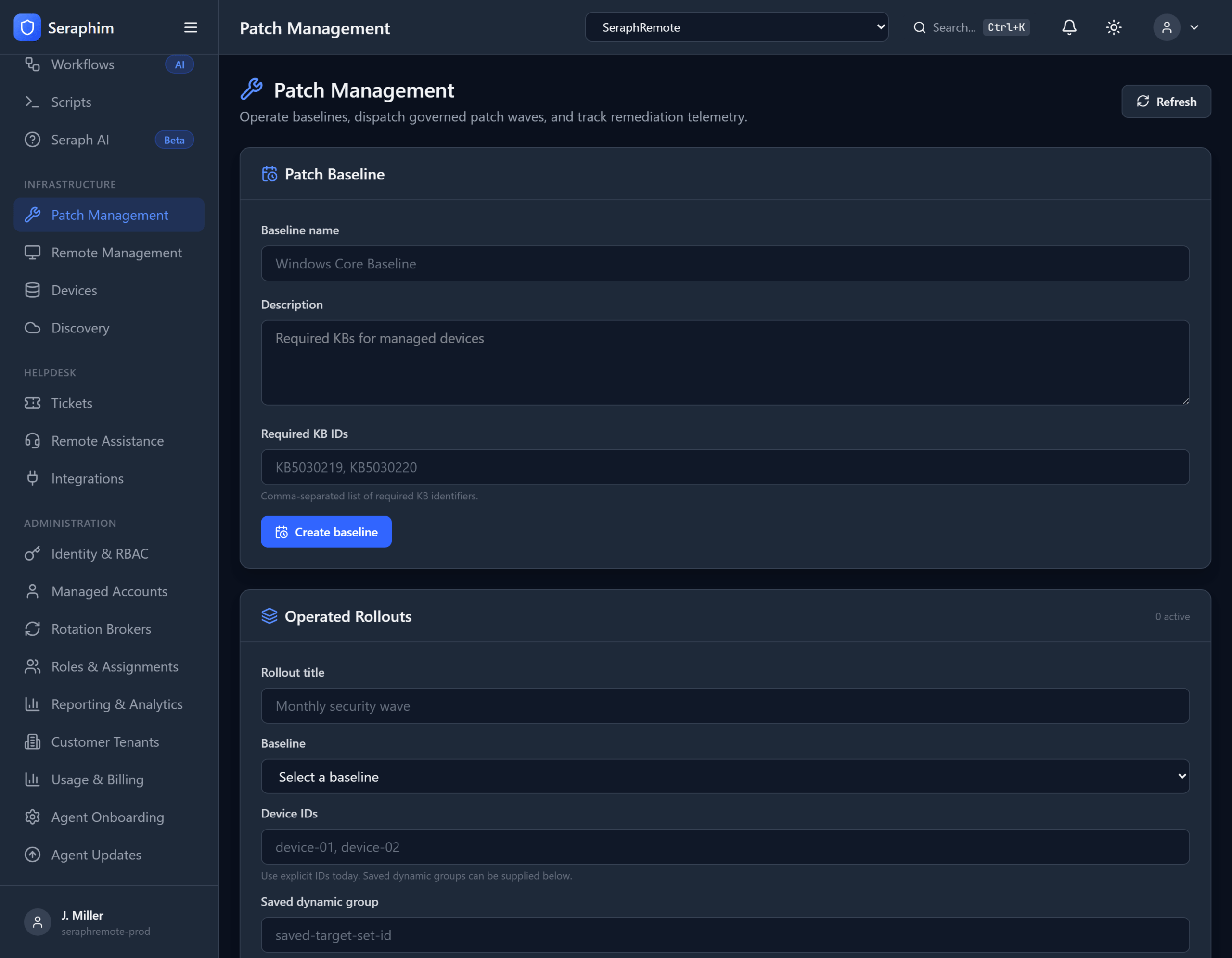
Patch Management in UNISIGN brings secure, policy-driven patching that integrates directly with your privileged access and compliance controls.
What It Means in Practice
Baselines You define approved patch levels and configurations for different device types, operating systems, or client environments. UNISIGN continuously compares devices against these baselines and flags any drift.
Governed Patch Waves Instead of ad-hoc patching, you orchestrate controlled “waves”:
- Test rings (pilot group)
- Staged rollout by department, client, or risk level
- Scheduled maintenance windows
- Automatic approval workflows tied to change management
Patching runs under governed sessions with proper credential injection and full audit logging.
Remediation Telemetry Rich, real-time visibility into patch success/failure rates, reboot status, vulnerability exposure, and remediation progress — all tied back to tickets and audit logs.
Real-World Workflow
- UNISIGN detects new critical vulnerabilities or baseline drift on enrolled devices.
- A patch wave is created and linked to a helpdesk change ticket.
- The system uses governed sessions + credential vault to deploy patches securely.
- Technicians (or automation) get full visibility and can intervene if needed.
- Post-patch telemetry confirms success, and the audit log records everything for compliance.
Why IT Support Organizations Need This
Patching is one of the highest-risk, highest-volume activities in IT support, yet most RMM tools handle it in isolation:
- Little governance or approval workflow
- Weak integration with privileged access controls
- Poor telemetry and reporting for audits
- High chance of breaking changes going unnoticed
Consequences include:
- Lingering vulnerabilities that attackers exploit
- Failed patches causing outages
- Compliance failures during audits
- Difficulty proving to clients that systems are properly maintained
UNISIGN integrates Patch Management tightly with the rest of the platform — Credential Vault, Just-In-Time Access, Governed Sessions, Audit Logs, and Device Management. This means patching is no longer a risky blind spot but a fully governed, auditable process.
Key advantages:
- Strong multi-tenancy (different baselines and waves per client)
- AI-driven insights and automation recommendations
- Export-ready reports for clients and auditors
- Reduced manual effort while increasing control and visibility
Bottom line: UNISIGN turns patch management from a chaotic, high-risk necessity into a secure, measurable, and compliant process. It gives MSPs and IT teams the ability to maintain strong security posture at scale without sacrificing speed or increasing operational burden.